

Nothing is Neutral
Every parent wants to give good things to their children; it’s the way God made us and reflects God’s character. Jesus said, “What father among you, if his son asks for a fish, will instead of a fish give him a serpent; or if he asks for an egg, will give him a scorpion?” However, the temptation we face as parents in 2025 is to say “yes” to every good thing that comes our way or every good thing our child asks for. Sports teams, dance classes, academic clubs, social events, and other extracurriculars, for example, are all good things. But every “yes,” by its very nature, is also a “no”. Nothing is neutral. Saying yes to a packed extracurricular schedule may mean saying no to family dinners, worship, church involvement, unstructured play, or even simple rest (i.e., Sabbath). The things your family says yes to will ultimately reveal, implicitly or explicitly, what your family values most.
All Education Is Value-Laden
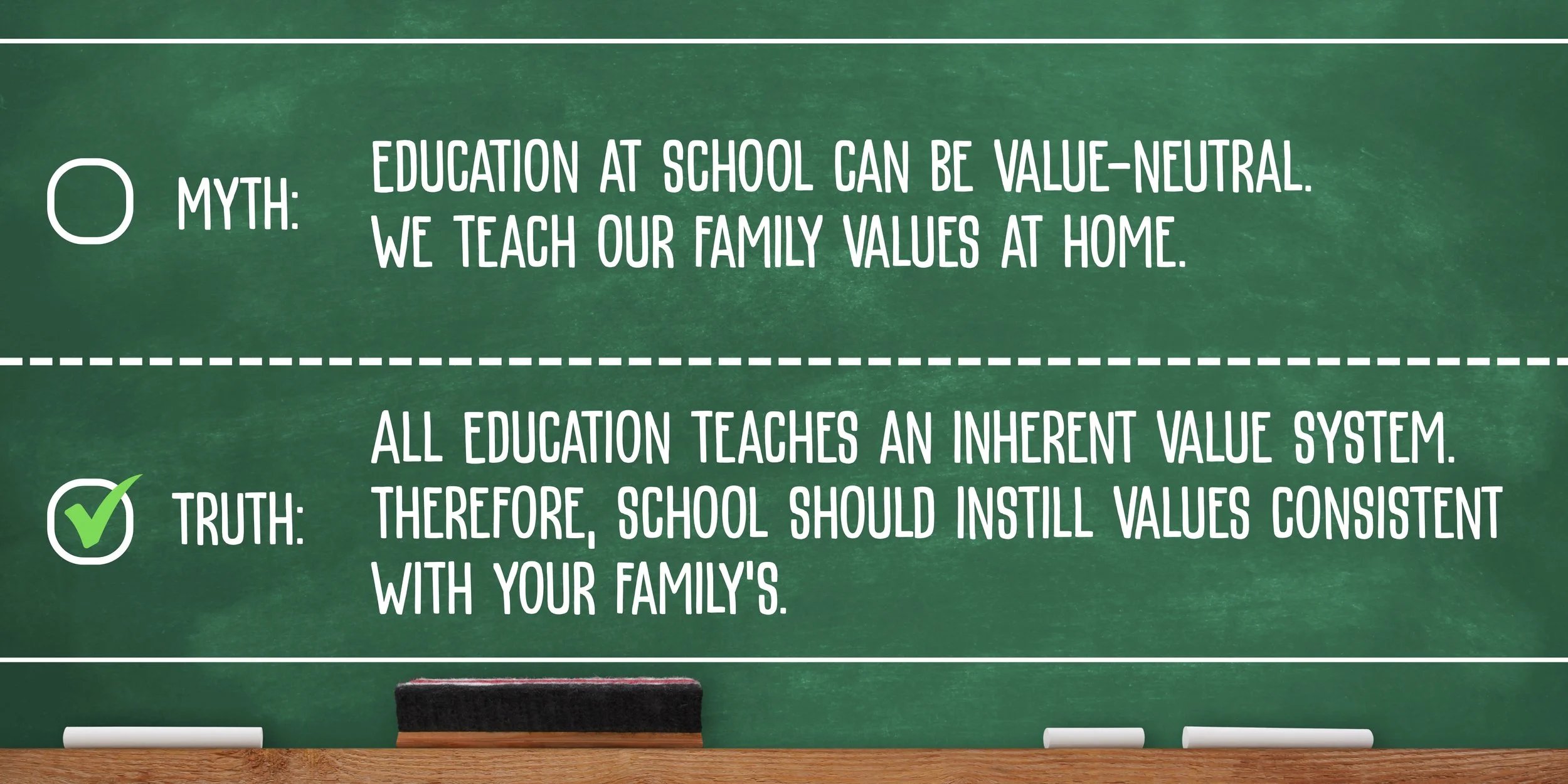
Modern education wants us to think of school as neutral, as the pure transfer of facts and skills from teacher to student. But education is never neutral. Nothing is neutral. Every school (public and private), every curriculum, every teacher, every classroom, subtly (or overtly) teaches a worldview. It communicates not only what to think, but how to think. It shapes what children learn to love, admire, and pursue. Parents must recognize that the school is not simply a place for acquiring knowledge; it is a moral and cultural incubator. It shapes affections, habits, and assumptions about the “good life” and what the good life looks like. But here’s the kicker: If the values taught in school are at odds with the ones practiced at home, a child is put in a confusing—and potentially painful—position: Whose values should they embrace? A child can only choose one.
Competing Loves
When a family’s values are not aligned with those of their school, it can feel like a tug-of-war on the soul of a child. For example, at a classical Christian school, students will be given a vision of the good life—one shaped by obedience to Scripture, self-control, humility, and family life centered on Christ. However, if these values are not true values of the home, the child will be left to navigate two competing worlds. The things we say yes to, extracurriculars, technology, media, behaviors, habits, relationships, etc., may tell a different story than what the school is teaching. If a child learns about the importance of Sunday worship, obedience to Scripture, and the power of prayer at school but comes home to a house that worships occasionally, rarely reads Scripture, and only prays at meals, the message becomes muddled. Children are perceptive. Eventually, the child will notice the inconsistency, and they will be forced, consciously or not, to choose which authority they trust and which vision of the good life they believe in.
Consistency is Key
This is why aligning the home, school, and church in your child’s education is essential. Children thrive when the messages they receive from the adults in their lives are unified, coherent, and consistent. When a child hears the same truths affirmed in the classroom, at church, and lived out at the dinner table, those truths take root.
Of course, none of us will live this out perfectly. Intentionality—not perfection—is the goal here. Parents are called not to be flawless, but to be faithful. The question is not, “Are we doing everything the school does?” but rather, “Do the rhythms and habits of our home, the things we say yes to, reflect the same priorities being taught at school and church?”
At the end of the day, your child’s heart will be shaped not just by the school they attend or the activities we say yes to, but by the pattern of life they see modeled day after day. So be courageous. Be intentional. Say no to some good things so you can say yes to the best things. Evaluate your family’s rhythms and habits and ask God for wisdom. And remember: nothing is neutral. Every yes, every no, every habit, and every priority is formative to our families.
Toward a life lived in Christ,
Chris Breiland, Head of School