

Order Out of Chaos
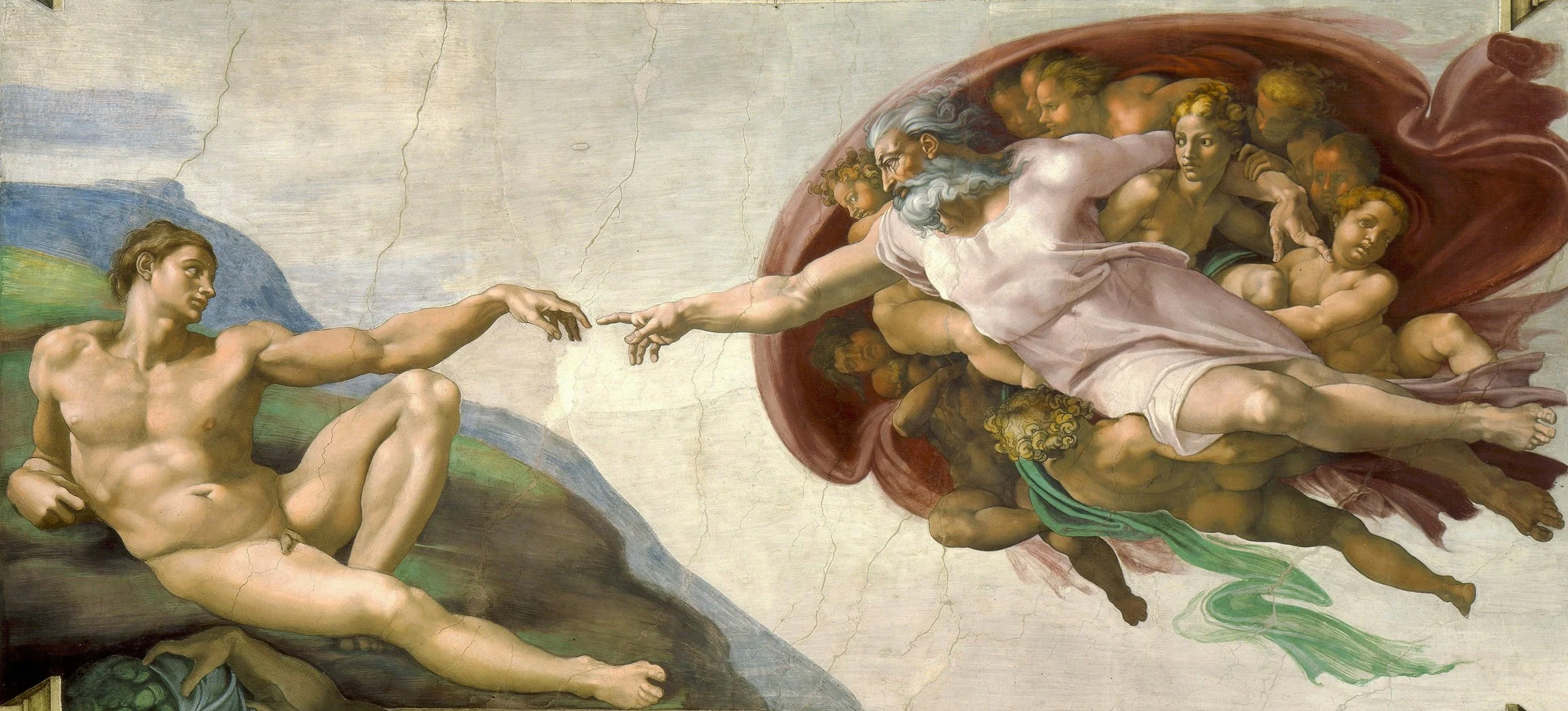
Michelangelo, The Creation of Adam, 1511–1512, fresco, Sistine Chapel, Apostolic Palace, Vatican City.
In 1511, at the height of the Italian Renaissance, Pope Julius II commissioned Michelangelo to paint a nine-panel fresco on the ceiling of the Sistine Chapel. Michelangelo, who was primarily a sculptor by trade and had already completed his Pietà and David statues, painted a masterpiece depicting the creation narrative from the book of Genesis.
In the first verses of Genesis, we meet a God who brings order out of chaos. “The earth was without form and void,” Genesis tells us, “and darkness was over the face of the deep.” Then, with steady intention, God speaks: light, sky, land, stars, animals, and finally man—each with its place, its purpose, and its rhythm. By the end of the sixth day, a chaotic void has become a unified cosmos: a world marked by beauty, meaning, and order. Michelangelo captured this scene perfectly.
As the story of Scripture unfolds, we can see that it’s God’s nature to bring order out of chaos. He gives seasons to the earth (Gen. 8:22), laws to Israel (Ex. 20), patterns for worship (Lev 1–7), and structure to the Church (1 Cor 12). Paul writes, “God is not a God of confusion but of peace” (1 Cor. 14:33). The Greek word for “peace” here is eirēnē (pronounced ay-RAY-nay), which is similar in meaning to the Hebrew word shalom, implying harmony, unity, and good order. I think it’s important to note that this is not the cold order of bureaucracy, but the living order of love. God’s loving order brings freedom, rest, and joy to humanity. It is the difference between a chaotic life of stress and a well-ordered life of purpose.
The Home as a Reflection of God’s Nature
As humans, we are image-bearers of God, called not only to believe in God but to reflect His nature in our daily lives. One of the clearest places this happens is in our homes. When we bring order to our spaces, our time, and our families, we are doing more than just tidying up—we are bearing witness to a God who made a world that actually works. A mother, for example, who takes the time and care to turn a house into a home for her family is not merely nesting, but reflecting her Creator.
Having a well-ordered home, however, doesn’t mean perfection or rigid control. Instead, it means building intentional rhythms (I like the word “liturgies”) of grace: meals at the dinner table, prayers and songs at bedtime, chores done with diligence, sabbaths kept in joy, technology kept in its proper place, and so on.These liturgies bring order to our homes and lives. When our children see that the day begins quietly with prayer and Scripture, time is spent with intentionality and purpose throughout the day, and theday ends in peace (eirēnē), they are seeing in small ways what thekingdom of God is like. The problem is that if we’re not mindful, our lives will always have a tendency to fall into disorder. Busy schedules, work, school, sports, commutes, get-togethers, etc., can compound toward a life of stress and chaos, undoing the peace that God desires for our families.
Practicing God’s Presence
In The Practice of the Presence of God, Brother Lawrence, a 17th-century monk working in a monastery kitchen in Paris, wrote that he felt just as close to God among the pots and pans as he did at the altar. He said:
“The time of business does not with me differ from the time of prayer; and in the noise and clatter of my kitchen, while several persons are at the same time calling for different things, I possess God in as great tranquility as if I were upon my knees at theBlessed Sacrament.”
Wow. I’m not sure if I'll feel the same closeness to God tonight when I’m cleaning up after dinner, I’m tired from work, my kids are arguing, and the house is strewn with toys and clothes…But I want to. How might our outlook on life change if we began to view the routine aspects of life—making breakfast, morning devotions, Sunday worship, exercise, family dinners, and cleaning the kitchen—as liturgies that help us to bring order out of chaos? Perhaps we’d begin to see the presence of God not just in the quiet moments of prayer, but also in the routine of everyday life—in the folding of laundry, the packing of lunches, the bedtime routines, and even the disciplining of children. Like Brother Lawrence, we might discover that God is not waiting for us at the end of our long list of tasks, but walking with us through them.
Closing the Gap: Finding God in the Ordinary
Perhaps my favorite detail of Michelangelo’s Sistine Chapel is in the hands of God and Adam. Michelangelo depicts the hand of God with a straight wrist and distinctly outstretched index finger, while Adam’s wrist and finger appear limp and pointed downward. The tension is palpable as the gap between God’s finger and Adam’s finger would easily be closed if Adam moved just an inch.

That little gap tells a profound story. God is ever-reaching, ever-initiating, and ever-desiring communion with us and our families. Adam, like many of us, is passive—close, but not quite reaching. The beauty of Michelangelo’s work is not just in the artistry, but in the theology: God does not wait for us to find Him in grand cathedrals, at church, or in big dramatic moments.He draws near to us in the ordinary moments of our lives. He is present in the busyness of a Monday morning, in the messiness of parenting, in the clatter of dishes, in the laughter of our children, and in the rituals of family life.
The invitation of the Christian life is to respond—to reach back. To choose, again and again, the slow work of ordering our lives around what matters most. To shape our homes and our habits with the awareness that God is a god of order, not disorder. To live not just with belief in God, but with attentiveness to His presence in all things.
At our little school, we believe that formation doesn’t happen only in the classroom or at church, but in the ordinary, repeated rhythms of family life. This is why we talk about liturgies of the household. It’s why we care about routines, habits, schedules, and yes, even chores. All of it can be worship if we have the eyes to see it.
As we look to the new school year, may we commit ourselves to the sacred work of bringing order out of chaos, not through control, but through love. Let us form homes where God’s peace can be felt.
Toward a life lived in Christ,
Chris Breiland, Head of School