

What is School?
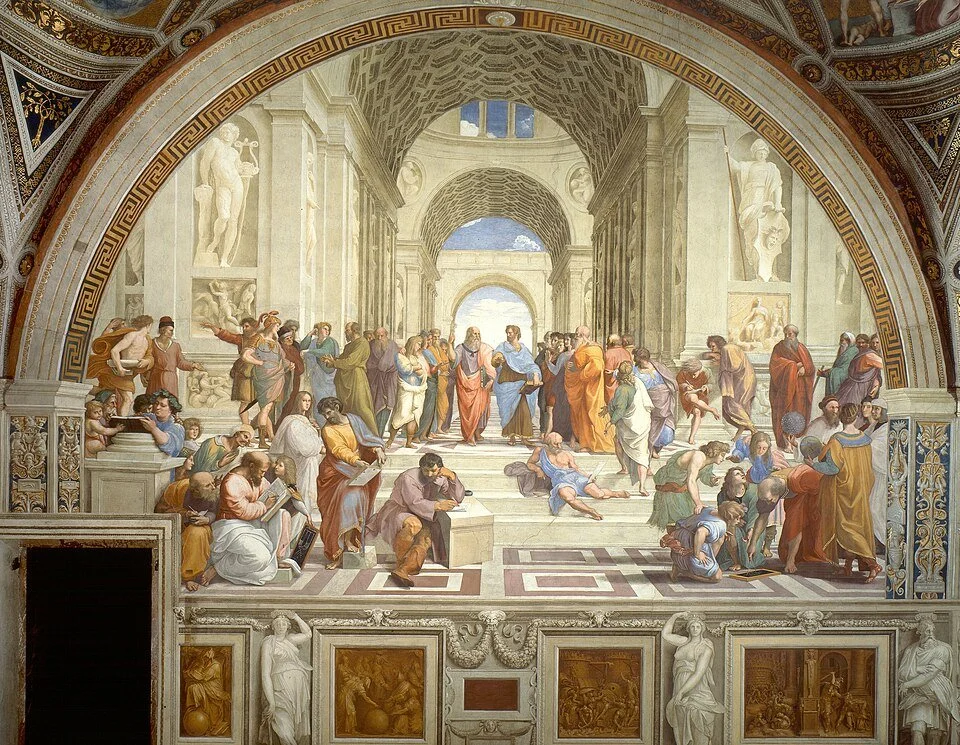
Raphael, The School of Athens, 1509–1511, Apostolic Palace, Vatican City.
If you’re new to classical Christian education (and most of us are), it won’t take long before you encounter a number of unfamiliar words that have largely fallen out of use among modern folks like us. Words like virtue, grammar, logic, rhetoric, liberal arts, and paideia, among others (We’ll explore these ideas throughout the summer). We’re unfamiliar with these words and concepts not because they are irrelevant in 2025, but because people tend to throw the baby out with the bathwater in pursuit of innovation and modernization. Modern public education is a prime example of this. Nonetheless, these words and ideas were essential to understanding a person's education, formation, and maturation for much of human history.
Let’s start with a word we are familiar with: School.
American schools come in all shapes and sizes today, but most are largely unrecognizable in purpose, methods, and outcomes from the schools that your great-grandparents attended and far different from anything the medievals or ancients would have called school. So, what changed and why? Well, from roughly 1870 to 1914, the second industrial revolution brought massive advancements in steel, electricity, oil, assembly lines, telecommunications, and railroads (not unlike the digital revolution in which we currently find ourselves). Though interrupted by the outbreak of World War I, the revolution brought about dramatic change in America in just 44 years. It became apparent to some during this time that to sustain an industrialized nation, the education system needed to shift away from the liberal arts and towards occupational training and specialization. Prior to this time, education was based on the seven liberal arts: grammar, logic, rhetoric, arithmetic, geometry, music, and astronomy. The great books of the Western world (e.g., Homer, Plato, Aristotle, Augustine, etc.), including the Bible, were essential reading. The point of education was to cultivate well-rounded, virtuous, and rational free citizens who could contribute to “the great conversation” that produced Western civilization. Education reformers like John Dewey sought to create an efficient public education system that prepared children to join the workforce. The liberal arts, great books, and training in virtue were seen as antiquated and thus irrelevant for a modern, industrialized population.
Interestingly, the word “school” comes from the Greek word scholē (pronounced skoh-LAY) that originally meant leisure, but not in the modern sense of relaxation or idleness. Instead, in the classical context, scholē referred to leisure time devoted to the pursuit of wisdom, contemplation, and learning. Scholē was not oriented toward work or occupation. In fact, it was the opposite. Work was for the purpose of scholē because scholē was restful, intriguing, regenerative, and edifying to a person.
Scholē is a concept we see throughout Scripture:
The Lord commanded a Sabbath from work so that we would rest, pray, and contemplate God and the world He created.
“Six days you shall labor, and do all your work, but the seventh day is a Sabbath to the Lord your God…” (Exodus 20:9-10a)
Jesus modeled scholē when he withdrew to quiet places to rest and teach his disciples.
“And he [Jesus] said to them, ‘Come away by yourselves to a desolate place and rest a while.’ For many were coming and going, and they had no leisure even to eat.” (Mark 6:31)
Scholē is what King David does in Psalm 8:1-4 when he contemplates how an almighty God would be mindful of him:
1 O Lord, our Lord,
how majestic is your name in all the earth!
You have set your glory above the heavens.
2 Out of the mouth of babies and infants,
you have established strength because of your foes,
to still the enemy and the avenger.
3 When I look at your heavens, the work of your fingers,
the moon and the stars, which you have set in place,
4 what is man that you are mindful of him,
and the son of man that you care for him?
I grew up in North Dakota and have vivid memories of being a kid, lying in the grass in my backyard, looking up at the stars in the night sky, and having thoughts similar to David's. Aristotle believed this deep wonder or curiosity to be the point at which learning begins. This is what the ancients called scholē. (Fun fact: when nighttime conditions are right, you can see the aurora borealis in North Dakota)
The point is that modern education has traded the slow pursuit of truth, virtue, and wisdom of a liberal arts education forefficient training oriented toward getting a job and going to work. By the way, I’m very much in favor of having a job and going to work. For the medievals and ancients, however, learning was the reward itself because it honors God and dignifies the person. Thomas Aquinas said, “Man was created for the contemplation of truth.” I agree and believe this is the purpose of school. It’s also the impetus for us to continue reading and learning as adults.
Classical Christian education, therefore, is a revival of liberal arts education, in which students learn to love learning for its own sake—not merely as a means to an end.”
Toward a Life Lived in Christ,
Chris Breiland, Head of School