

Get Wisdom

Two women came before King Solomon with a heartbreaking dispute. Both women lived in thesame house and had recently given birth, but one of the babies had died during the night. Each woman claimed that thesurviving child was hers. With no witnesses and no clear evidence, Solomon proposed a shocking solution: to cut the living child in two and give each woman half. One woman immediately agreed, but the other, overwhelmed with compassion, pleaded for thechild’s life to be spared and offered to give him up. Recognizing the true mother by her selfless love, Solomon gave the child to her. This bold judgment stunned the people of Israel and revealed the depth of Solomon’s God-given wisdom. This true story is told in 1 Kings 3:16-28 and depicted in various artworks like the one below, TheJudgement of Solomon by Italian Renaissance master, Giorgione (c.1502–1505).
The question is: How does a person gain the wisdom to navigate difficult life circumstances like this?
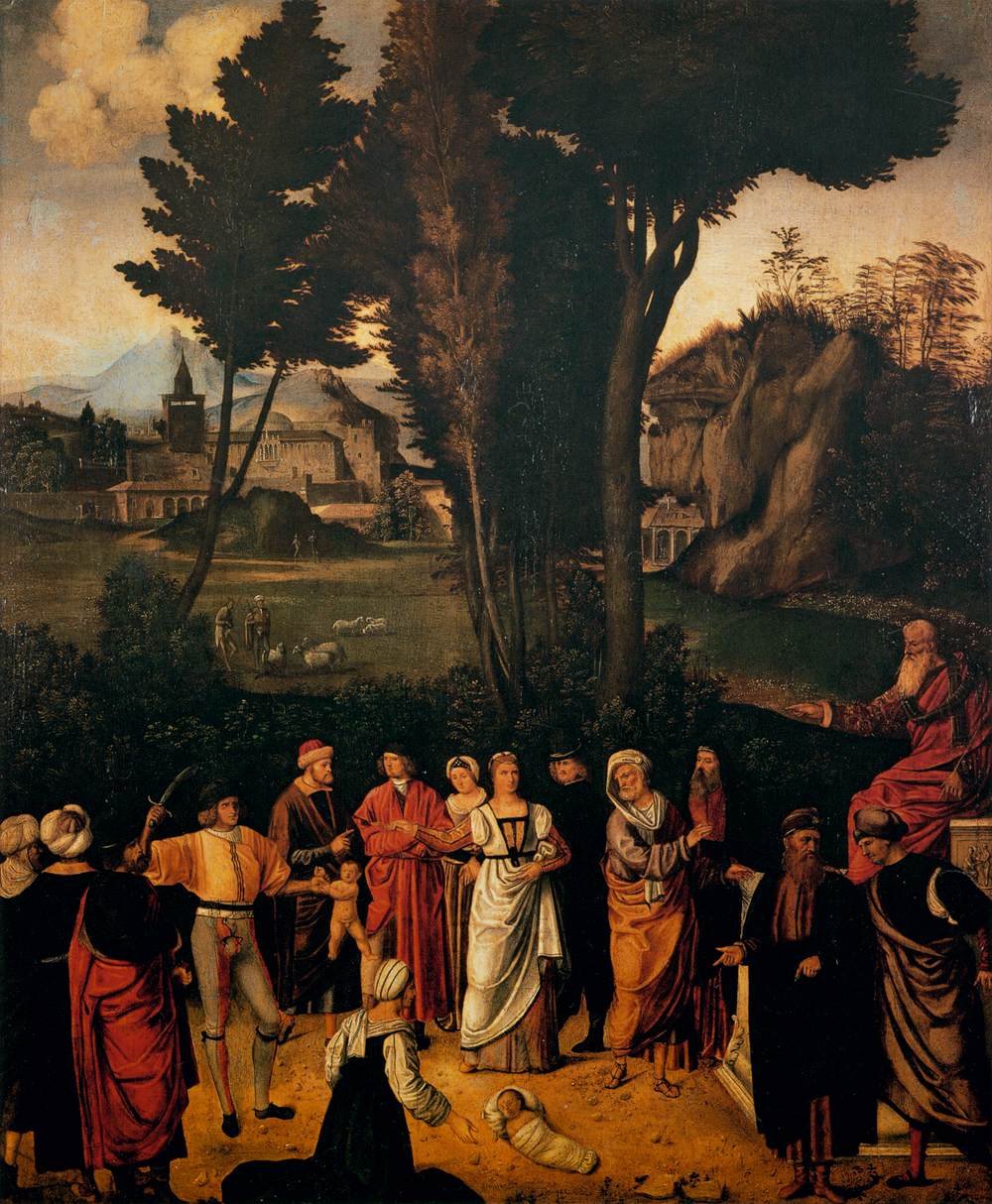
Giorgione, The Judgement of Solomon, c. 1502–1505, oil on canvas, Gallerie dell’Accademia, Venice, Italy.
Imagine if the Lord God appeared to you in a dream tonight and said, “Ask for whatever you want me to give you,”what would you ask of Him? Health and long life? Wealth? Power? Happiness? World peace? There is no shortage of good things for which we might ask.
Prior to Solomon’s wise judgment depicted above, the Lord God appeared to Solomon in a dream one night. In the dream, the Lord told Solomon, “Ask for whatever you want me to give you”. To which Solomon replied:
“6…You have shown great and steadfast love to your servant David my father, because he walked before you in faithfulness, in righteousness, and in uprightness of heart toward you. And you have kept for him this great and steadfast love and have given him a son to sit on his throne this day. 7 And now, O Lord my God, you have made your servant king in place of David my father, although I am but a little child. I do not know how to go out or come in… 9 Give your servant therefore an understanding mind to govern your people, that I may discern between good and evil, for who is able to govern this your great people?” (1 Kings 3:6-9)
Solomon, like his father David before him, was chosen and blessed by God, but also human and deeply flawed. David committed adultery with Bathsheba and had her husband, Uriah, murdered to cover up his sin (sin for which he repented in Psalm 51). In Solomon’s early years as king, he married Pharaoh’s daughter to create a political alliance between Israel and Egypt—a big no-no considering Egypt had enslaved Israel for 400 years and God prohibited intermarriage with them (Deut. 7:3-4). Nonetheless, despite his flaws and shortcomings, the Lord responded favorably to Solomon’s request for wisdom:
10 It pleased the Lord that Solomon had asked this. 11 And God said to him, “Because you have asked this, and have not asked for yourself long life or riches or the life of your enemies, but have asked for yourself understanding to discern what is right, 12 behold, I now do according to your word. Behold, I give you a wise and discerning mind, so that none like you has been before you and none like you shall arise after you. 13 I give you also what you have not asked, both riches and honor, so that no other king shall compare with you, all your days. 14 And if you will walk in my ways, keeping my statutes and my commandments, as your father David walked, then I will lengthen your days.” (1 Kings 3:10-14)
Out of all the things for which Solomon could have asked, he asked for wisdom and understanding, which pleased theLord. Interestingly, by asking for wisdom, the Lord also granted him riches, honor, and a long life to boot.
Now, I don’t think we need to view this as a genie-in-a-bottle situation where
Solomon makes a wish, and poof God makes him instantly healthy, wealthy, and wise—though that’s not out of God’s prerogative. It seems reasonable, however, that in seeking God first and living according to God’s laws, Solomon became wealthy, honorable, and long-lived as a result.
This seems to follow the basic logic of the Bible’s teaching on wisdom:
Proverbs 1:7
“The fear of the Lord is the beginning of knowledge; fools despise wisdom and instruction.”
Ecclesiastes 7:12
“Wisdom preserves the life of him who has it.”
James 1:5
“If any of you lacks wisdom, let him ask God, who gives generously to all without reproach, and it will be given him.”
It seems that wisdom begins with reverence for God, leads to life and flourishing, and is available to anyone who sincerely asks for it.
So, what does all of this have to do with school?
Too often, education is reduced to test scores, career preparation, or the accumulation of knowledge. While those things have value, they fall short of the deeper goal: the cultivation of wisdom. Wisdom is more than just knowing facts; it’s about knowing how to live rightly—how to discern good from evil, truth from falsehood, and what is meaningful from what is merely noise. That’s what Solomon asked for. That’s what God honored.
A truly excellent education teaches students not just how to think, but how to live. It shapes the heart as well as the mind. It aims at developing people of character, discernment, humility, and virtue—people who can navigate life’s complexities with grace and integrity.
This is why the fear of the Lord is called the beginning of wisdom. True education begins with reverence for the God who made us, knows us, and desires to shape us. When students are invited to pursue knowledge within the framework of faith, they are not just being informed—they are being transformed.
In the classroom, in books, in art, in math, in science, in Scripture, and in life, we are ultimately chasing what Solomon valued most: wisdom. And as James 1:5 reminds us, God still gives it generously to those who ask.
This week’s homework is an excerpt from Wisdom and Eloquence by Robert Littlejohn & Charles T. Evans. I think you’ll find it helpful as you ponder the purpose of education.
Toward a life lived in Christ,
Chris Breiland, Head of School