

Repetitio Mater Memoriae
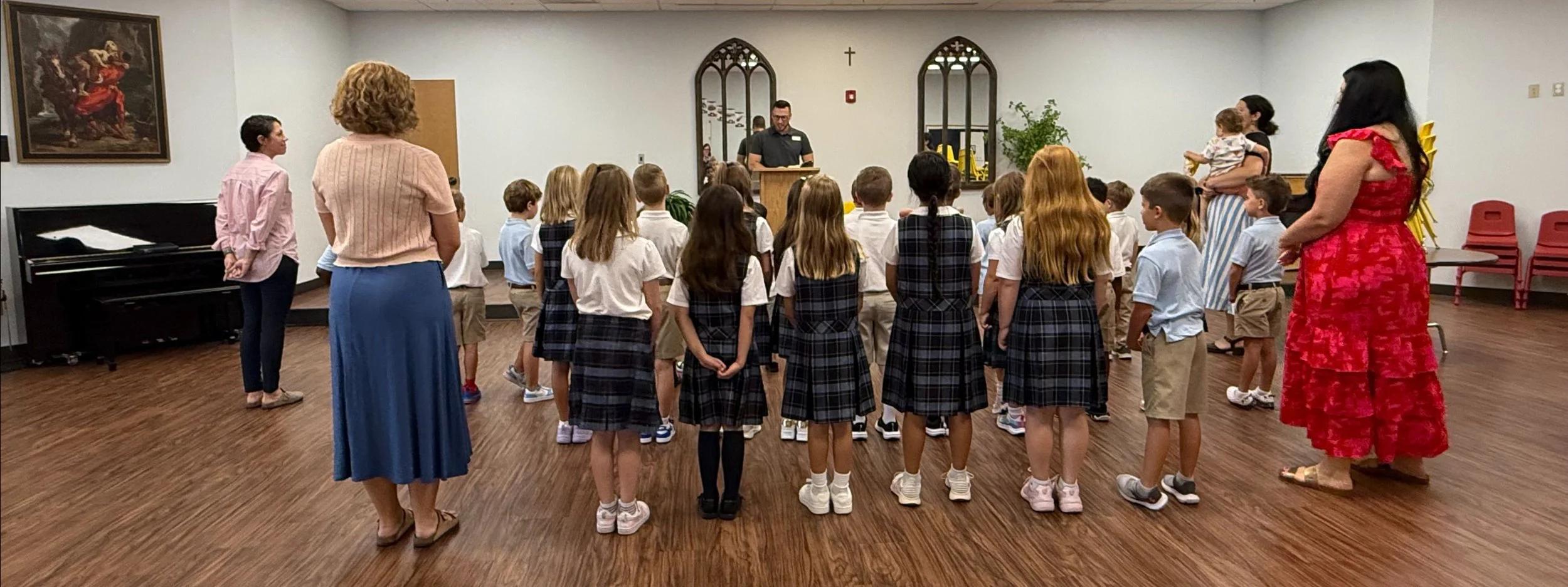
Every Monday morning, we hold an all-school assembly where I lead our students and teachers through a brief liturgy. We participate in this liturgy together to begin the week, and the teachers then carry those same elements into their classrooms each day. Liturgies matter because habits matter. What we do repeatedly shapes not only how we think and behave, but also—most importantly—what we love. The Latin phrase repetitio mater memoriae means “repetition is the mother of memory.” In other words, repetition strengthens both our affections and our grasp of the good, the true, and the beautiful—it helps make learning permanent.
I thought it might be insightful to walk you through our Monday morning routine and provide a brief commentary on why we do what we do.
MORNING GREETING
LEADER: I greet you this morning in the name of the Lord! The Lord be with you!
Students: And also with you!
LEADER: This is the day that the Lord has made!
Students: Let us rejoice and be glad in it!
Sound familiar? We use this greeting every Sunday morning at Asbury Church. Historically, this greeting has its roots in the medieval church, although God’s people have always greeted one another “in the name of the Lord” (e.g., Ruth 2:4). It serves as a good reminder to give thanks for the sheer fact that God has given us another day.
MONTHLY HYMN
We sing one new hymn per month as a school. For September, we are singing “All Creatures of Our God and King." The lyrics come from St. Francis of Assisi’s “Canticle of the Sun,” written in 1225, which is one of the oldest pieces of literature written in the Italian language. While there are a lot of good songs we could sing together, we favor the old hymns. Hymns aren’t just “songs we sing in church” — they carry deep theological, educational, and spiritual weight for Christians of all ages.
CATECHISM
We use the Echo Catechism from Seedbed Publishing, which is based on The Catechism of the Methodist Episcopal Church, published in 1885. A catechism (from the Greek katēcheō meaning “to instruct”) is a summary of the Christian faith written in question-and-answer format. The ancient Church would use a catechism to prepare candidates for baptism. In our morning assembly, I will ask the students the question, and they will recite the answer verbatim from memory. For example:
Q. Who made you?
A. God.
Q. Who is God?
A. The Creator of All Things
Q. What is God?
A. An uncreated Spirit.
SCRIPTURE READING
As a Bible-reading school in a Bible-reading church, we read Scripture that supports or provides insight into the catechism reading for the day. The creation narrative in Genesis 1-2 is filled with theology undergirding the catechism questions referenced above.
MANNER OF THE WEEK
At ACS we practice manners. We start simple with “Smile!” and “Look people in the eyes when you speak to them,” and build up to basic table etiquette like “Don’t place your elbows on the table if food is present.” Good manners teach children respect, consideration, and self-discipline, helping them build positive relationships and make thoughtful choices. Beyond politeness, manners shape character and help children love others well.
BIRTHDAY CELEBRATIONS
Every child is a gift from God and a life worth celebrating. We acknowledge birthdays weekly by singing and praying for the student.
CLASS POETRY RECITATION
Memorization and recitation are an essential part of a classical education. Each week, one class recites a poem from memory in front of the school.
This week, our kindergarteners recited Hurt No Living Thing by Christina Rosetti (1876).
Hurt no living thing:
Ladybird, nor butterfly,
Nor moth with dusty wing,
Nor cricket chirping cheerily,
Nor grasshopper so light of leap,
Nor dancing gnat, nor beetle fat,
Nor harmless worms that creep.
THE LORD’S PRAYER
Our Father, who art in heaven,
hallowed be thy Name.
Thy kingdom come.
Thy will be done,
on earth as it is in heaven.
Give us this day our daily bread.
And forgive us our trespasses,
as we forgive those who trespass against us.
And lead us not into temptation,
but deliver us from evil.
For thine is the kingdom, and the power, and the glory,
for ever and ever. Amen.
Every ACS student typically has this memorized after the first week or two of school. We pray this aloud together toward the end of our assembly time. We say the version that uses “trespasses”.
THE DOXOLOGY
Praise God, from Whom all blessings flow;
Praise Him, all creatures here below;
Praise Him above, ye heav’nly host;
Praise Father, Son, and Holy Ghost.
Doxology comes from the Greek word doxazō, which means to praise, worship, or glorify. This is the first hymn that students learn at ACS, and all students typically have it memorized after one or two weeks.
THE BENEDICTION
The Lord bless you and keep you;
The Lord make his face to shine upon you and be gracious unto you;
The Lord lift up the light of his countenance upon you and give you peace;
And now may the blessing of God Almighty,
The Father, the Son, and the Holy Spirit,
Be with us and remain with us now and forever.
Amen.
At the close of our assembly, students lift their hands to receive the Priestly Blessing from Numbers 6:24-26. From there, I send them back to their classrooms with the reminder to “Work hard for the Lord!”
Sure, it’s repetitive—but intentionally so. Day after day and week after week, our students are being shaped by the words, prayers, songs, and habits of the Christian faith. These rhythms root them in God’s truth and give them words of worship that will remain with them for a lifetime. In these simple, repeated practices, we are building memory, character, and affection for Christ that will endure far beyond their school years. Remember: Repetitio Mater Memoriae. Repetition is the mother of memory.
Toward a Life Lived in Christ,
Chris Breiland, Head of School