

The Old Deluder Satan Act: Why You Shouldn’t Squander Your Literacy
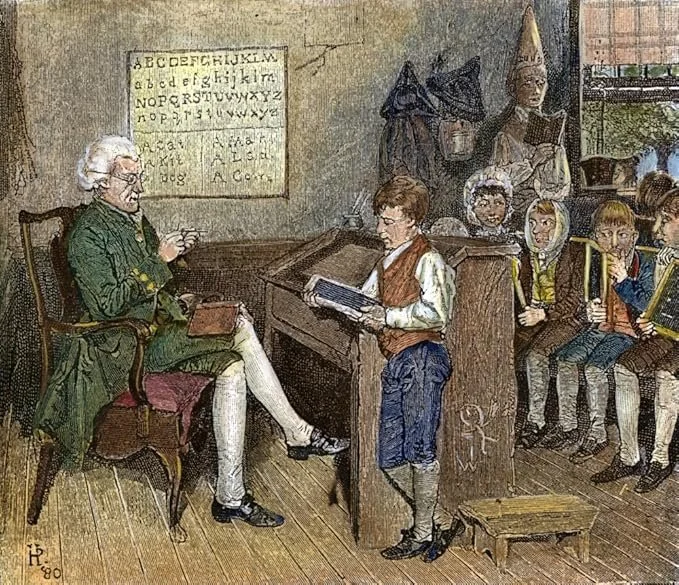
Before standardized tests, before college admissions became the top priority, and before STEM and “career readiness” entered the conversation, education in the American colonies had one simple and urgent goal: to teach children to read so that they could read the Bible.
In 1647, the Massachusetts Bay Colony passed one of the first education laws in colonial New England—one with an unforgettable name: The Old Deluder Satan Act. The law begins with a clear conviction: “It being one chief project of that old deluder, Satan, to keep men from the knowledge of the Scriptures…” Click here to read the full text.
The Puritans understood two things:
That Satan’s strategy is to keep people ignorant of the Bible.
Ignorance is not a neutral thing.
Ignorance has consequences for people and society. The Puritans knew this from the events leading to the Protestant Reformation. If people cannot read, then they cannot access Scripture for themselves. If people cannot access Scripture, then they are more easily led astray. Ignorance, then, often results in the manipulation of the ignorant, lawlessness, immorality, and poverty.
In response, the law required every town of fifty or more families to establish an elementary school, appoint and pay a teacher, and teach children to read and write using the Scriptures. Towns of 100 families or more were required to go a step further and establish a grammar school, where students studied Latin and Greek in preparation for University (Harvard being the only option at the time).
The Puritans believed that if children could read and study the Bible for themselves, then they would be better equipped to resist error and live wisely. Without the ability to read, a person could not understand Scripture, the laws of the land, or participate meaningfully in civil society.
In 2026, we live in the most functionally literate era in all of human history. That is, the majority of people in the world can “read” in the modern sense of decoding words on a page, sending a text, or reading signs. However, functional literacy is not the same thing as true literacy. The Puritans were not aiming for mere decoding; they were aiming for understanding that led to wisdom. They wanted citizens who could discern truth from falsehood and order their lives accordingly.
We live in an age of endless information, but shallow comprehension is everywhere. People skim, scroll, and consume words, but struggle to follow an argument, think critically, or recognize when they are being misled. It is obvious that the “old deluder” has not retired; he has simply adapted.
Literacy is a gift from God to be used, not buried like the talents in Christ’s parable. God gave us minds capable of understanding, reasoning, and discerning truth. To neglect these gifts is to return them unfruitful. To read, reflect, and think deeply is to invest the talents we have been given, multiplying wisdom for our families and for society.
So, don’t squander your literacy. Read deeply. Write prolifically. Use the gift that God gave you.
Cotton Mather (1663–1728), a Puritan minister and prolific writer in Colonial New England, put it well:
“If ever there be any Considerable Blow given to the Devil's Kingdom, it must be, by Youth Excellently Educated. It is a serious Thing, a weighty Thing, and a thing that hath much of the Interest of Christ, and of Christianity in it, that Youth be well-trained up, and that Schools, and School-Masters be maintained. Learning is an unwelcome guest to the Devil, and therefore he would fain starve it out.”
I could not agree more.
Toward a life lived in Christ,
Chris Breiland
Head of School